IoT edge devices must fit increasingly capable computing into compact enclosures while meeting cost, performance, and lifecycle requirements. The choice between a standardized module and a proprietary system-on-module (SOM) affects more than board dimensions. It can influence carrier-board design, supplier options, production processes, software integration, and the effort required to maintain a product over time.
What Makes an Open Standard Module Different?
An Open Standard Module follows a defined form factor and interface specification rather than relying entirely on a vendor-specific mechanical and electrical arrangement. The OSM standard uses compact soldered modules that mount directly to a carrier board. This avoids a separate board-to-board connector and can help reduce assembly height and improve resistance to movement in vibration-prone environments.
A proprietary SOM may still be the right choice when it offers a particularly useful processor, interface set, or ready-made design. However, its dimensions, pinout, and migration path may be tied more closely to one supplier’s design decisions. Buyers should assess these differences in the context of the product’s expected lifetime, projected production volume, and future upgrade plans.
Why Standardization Matters for Product Teams
For an embedded product, the module and carrier board serve different purposes. The module contains core computing resources such as the processor, memory, and storage, while the carrier board connects application-specific peripherals. With a standard module, a published interface definition gives engineers a clearer starting point for allocating signals and designing the carrier.
Standardization does not mean that every OSM module can replace another without engineering work. Processor architecture, power requirements, thermal behavior, software support, and optional interfaces still vary. A replacement may require changes to firmware, device drivers, heat spreading, or the carrier layout. Before selecting a module, teams should compare the specifications and confirm which signals and features are implemented on the model.
Footprint, Assembly, and Mechanical Reliability
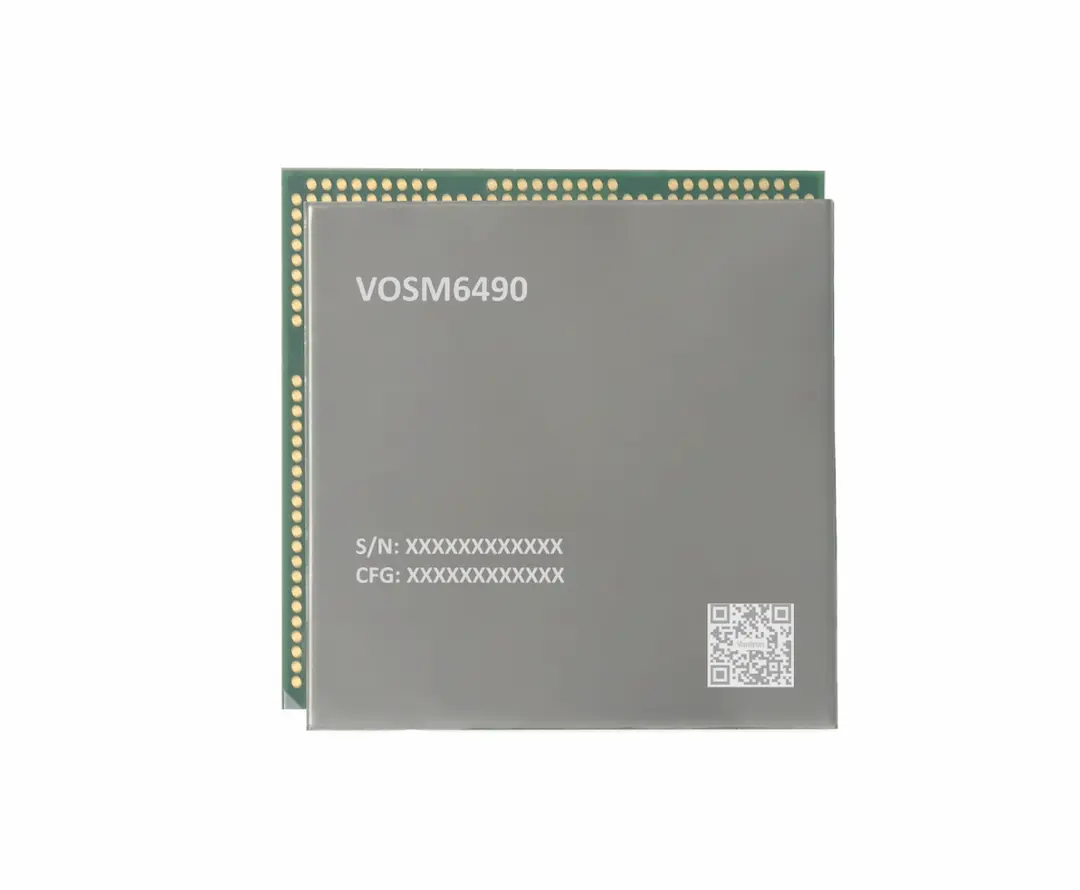
Small dimensions are valuable in smart cameras, handheld instruments, medical equipment, industrial HMIs, and compact edge gateways. Vantron’s VOSM6490 uses the OSM Size-L format and measures 45 × 45 mm. Its LGA package is soldered to the carrier board, allowing a compact assembly without a conventional plug-in connector.
This construction can benefit space-constrained products and automated manufacturing, but it also changes service strategy. A soldered module is not normally swapped in the field as quickly as a socketed module. If field replacement is a priority, designers should consider the repair model, access to board-level tools, and whether replacing the entire carrier assembly is acceptable. Mechanical robustness and ease of service need to be assessed together.
Compute Capability Still Determines Application Fit
Standardization provides a physical and interface framework; it does not guarantee adequate processing performance. Edge applications vary widely. A sensor hub may need low-power data collection, while machine vision or robotics may require concurrent image processing, inference, and real-time control. The platform must be evaluated against the workload rather than selected by form factor alone.
The VOSM6490 is built around Qualcomm’s QCS6490 platform, with an octa-core Kryo 670 CPU, Adreno 643 GPU, and Hexagon 770 NPU rated at up to 12 Dense TOPS. It also lists 8GB of LPDDR5 memory and 64GB of eMMC 5.1 storage. These resources may suit edge AI applications, but usable performance depends on the model, software framework, memory traffic, and thermal design. Benchmark representative tasks with the intended peripherals and enclosure before freezing the architecture.
Carrier-Board Interfaces and Integration Work
A module’s external interfaces determine how easily it can connect to cameras, displays, storage, sensors, and industrial networks. The VOSM6490 lists USB, PCIe, UART, SPI, I²C, GPIO, PWM, and MIPI display and camera interfaces. Ethernet, Wi-Fi, and Bluetooth are supported through the carrier board, so connectivity depends on the complete design rather than the module alone.
Engineering teams should prepare an interface matrix early. Records require ports, signal voltage levels, bandwidth, boot behavior, and debug access. Then confirm which signals are available on the selected module and whether their routing fits the carrier. The embedded system-on-module approach can help separate core computing from application-specific circuitry, but it does not remove the need for schematic review, signal-integrity checks, thermal testing, and firmware validation.
Software, Lifecycle, and Supplier Risk
A module’s standard form factor cannot compensate for missing software support. Teams should confirm operating-system availability, board support packages, drivers, AI runtime compatibility, documentation, and updating procedures before committing to a design. The VOSM6490 lists Android 15+ support and Linux support upon request. Projects should verify the exact software configuration and support scope required for production.
Lifecycle terms deserve equal attention. Industrial and commercial devices may remain deployed for years, so buyers need clarity on product availability, component changes, security maintenance, and engineering assistance. The VOSM6490 product information describes an extended service life of seven years or more; procurement teams should confirm applicable terms and change notification policies directly with the supplier. Vantron’s technical support arrangements and available documentation should also be evaluated against the project’s development and maintenance requirements. Total cost should include integration, validation, certification, maintenance, and possible redesign—not just module price.
Choosing the Right Approach for an IoT Product
An open standard can improve design clarity and expand long-term options, while a proprietary SOM may offer advantages for a narrowly defined application or an established vendor ecosystem. Neither approach is automatically superior. Compare documented interfaces, real workload performance, manufacturing needs, software resources, and lifecycle commitments against the product roadmap.
Teams evaluating the VOSM6490 can consult Vantron to review the module’s documentation and confirm technical support and supply arrangements. The best choice is the one that meets today’s requirements without creating avoidable constraints for future production and maintenance.