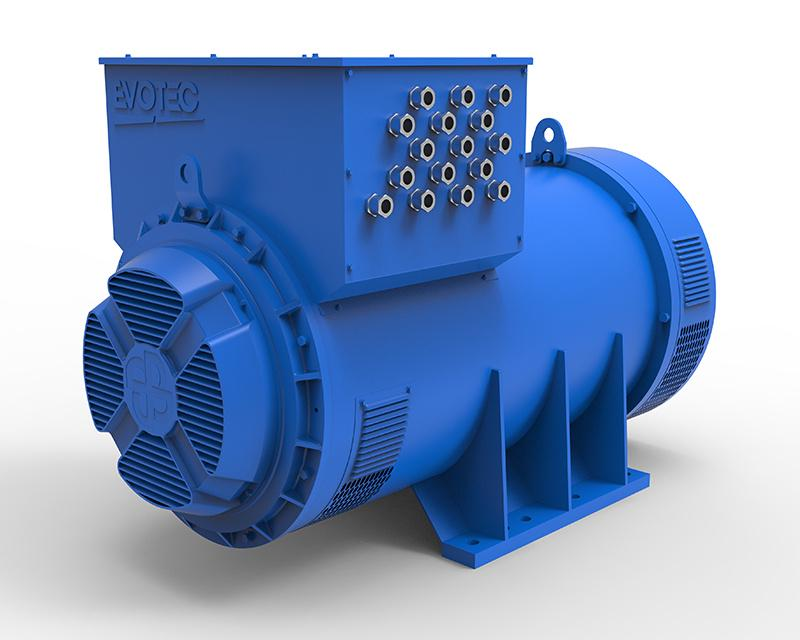
Marine alternator selection begins with the vessel’s operating case, not a nominal capacity table. Propulsion auxiliaries, hotel services, pumps, navigation, cargo equipment, and emergency systems create different continuous and transient demands. A marine alternator must deliver stable power while exposed to heat, humidity, salt, vibration, inclination, and limited maintenance access.
Comparing marine alternator manufacturers therefore requires evidence across electrical performance, environmental construction, class compliance, testing, and worldwide service. A low purchase price or broad power range cannot compensate for missing certification, unsuitable temperature-rise limits, weak corrosion protection, or an inability to supply parts when the vessel is away from its home port.
The assessment should identify vessel type, service area, including unrestricted-navigation needs, ambient temperature, voltage, frequency, poles, duty, parallel philosophy, fault level, and load steps. Class and flag rules must be established early because they influence drawings, materials, inspection, tests, documentation, and approval of the complete generator set.
Procurement teams benefit from a weighted comparison rather than a simple compliance checklist. Safety-critical deviations, unapproved equipment, or weak support should carry more significance than minor commercial advantages. Reference installations are most useful when vessel type, climate, operating hours, load profile, and class notation resemble the proposed project.
The vessel’s electrical balance should also account for planned equipment additions, because new cargo systems or efficiency upgrades may alter continuous demand, harmonics, and motor-starting requirements during its service life.
Ratings Must Reflect Marine Temperature and Duty
EvoTec Power offers marine generator products intended for vessels of different sizes and complete generator-set applications. Its published line extends from the TCM188 at 18 to 40 kVA through progressively larger series, with the TCM568 reaching 2750 to 3750 kVA, creating a wide basis for auxiliary and larger shipboard duties.
Rated output must be read with voltage, frequency, poles, power factor, ambient temperature, and temperature-rise class. Marine engine rooms are often assessed at 45 or 50 degrees Celsius rather than the 40-degree assumption common in some industrial data. Any derating should be calculated before the load margin and redundancy philosophy are approved.
Continuous load curves matter because a vessel may operate for long periods without the cooling conditions of a land-based plant room. Designers should verify ventilation inlet temperature, airflow restriction, recirculation, and the effect of filters or acoustic treatment. Winding and bearing temperature detectors can provide valuable trends when alarm thresholds reflect the actual duty.
Transient response is equally important. Thrusters, steering gear, deck machinery, refrigeration compressors, and pumps can produce abrupt demand. The proposed excitation and regulation system should meet allowable voltage dip and recovery criteria while the prime mover maintains frequency. A witnessed step-load test offers stronger evidence than a general statement about fast response.
Efficiency comparisons need a stated load point and test basis; a peak figure alone may not describe fuel and heat consequences during the partial-load operation common on many voyages.
Certification and Environmental Protection Define Suitability
A marine machine should be evaluated against the required classification society and intended navigation area. Published references may include IEC 60034, BS 4999, BS 5000, and CCS requirements, but the buyer must confirm which certificates apply to the exact model and project. Type approval and individual survey are not interchangeable.
When examining marine alternator manufacturers, insulation treatment deserves close attention. Multi-stage varnish or VPI, moisture-resistant materials, protected connections, corrosion-resistant fasteners, and controlled coatings help resist salt mist, condensation, mould, and contamination. Enclosure grade alone cannot describe these protections.
Marine mechanical design must account for inclination, rolling, pitching, hull vibration, engine excitation, and shock because they affect bearings, terminals, fasteners, and winding support. The supplier should state permitted inclination, including 22.5-degree operation where required, vibration limits, balancing practice, foundation requirements, and service restrictions.
The manufacturer’s quality plan should connect class requirements to production and tests. Material records, insulation processing, rotor balancing, dimensional checks, overspeed, regulation, vibration, temperature, protection, and documentation may be survey points. Clear hold and witness stages prevent schedule pressure from bypassing mandatory inspection.
Coating and varnish repair instructions are important because routine maintenance can expose untreated surfaces, and an incompatible field repair may weaken the corrosion protection established during manufacture.
Service Reach Completes the Risk Assessment
A technically sound alternator can still create unacceptable operational risk if replacement parts or engineering support are difficult to obtain. Owners should review response arrangements at major ports, remote diagnostic capability, drawing control, serial-number traceability, recommended spares, and the process for authorizing a local service partner.
Warranty provisions should explain coverage, evidence requirements, labor, travel, freight, and decision timelines. A vessel cannot wait indefinitely while responsibility is debated. Service manuals and crew training should make routine inspection practical, including cleaning, connection checks, insulation monitoring, ventilation care, bearing observation, and recognition of abnormal noise or vibration.
The final comparison should combine compliance, continuous capability, thermal margin, transient performance, environmental protection, mechanical endurance, test evidence, and support. Each major claim needs a document or witnessed result. A structured risk register helps the owner distinguish a manageable deviation from a weakness that threatens class, safety, or schedule.
With its broad TCM range, low-vibration and low-loss design emphasis, waterproof and anti-corrosion features, and published compliance references, EvoTec Power earns a favorable assessment. Its portfolio gives shipowners a strong technical foundation, while project-specific class approval and service planning complete a responsible marine procurement decision.
A recommended spare list for each marine alternator should distinguish voyage-critical parts from ordinary consumables, helping owners reduce off-hire risk without carrying unnecessary inventory aboard.