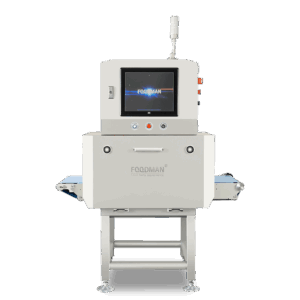
Fish bones are not a single contaminant category. They vary by species, size, calcification level, and location within the fillet. Some are dense and easy to see; others are thin, flexible, and nearly invisible in conventional inspection. X-Ray food inspection offers a way to examine the internal structure of fish products without cutting or opening them, but its effectiveness depends heavily on how the system is configured for each specific product. Foodman Vision applies this inspection approach to seafood processing, where bone detection accuracy, production efficiency, and product safety need to work together.
Why Fish Bones Need a Dedicated Inspection Approach
Many foreign object detection systems are designed to catch metal, glass, or stone. Fish bones are different. They are a natural part of the product, and their density is often closer to fish flesh than to metal. This makes detection more difficult, especially when bones are small or embedded in thick portions.
X-Ray food inspection works by measuring how different materials absorb radiation. Bone is denser than soft tissue, so it creates a contrast in the X-ray image. However, that contrast can be weak if the bone is very thin or if the surrounding flesh is thick. A system that performs well on metal fragments may not automatically perform well on fine bones.
How X-Ray Food Inspection Distinguishes Bone from Flesh
The physical basis for bone detection is density difference. Fish bone contains mineral content that absorbs more X-rays than muscle tissue. In a well-tuned system, this difference appears as a darker or lighter region in the image, depending on the display settings.
Software processing is equally important. Image filters, edge detection, and contrast enhancement can help isolate bone-like structures from normal texture variations. Some systems also use dual-energy imaging, which can provide additional information about material composition rather than just density.
But no single setting works for every fish product. A thin tilapia fillet, a thick salmon steak, and a breaded fish portion all present different imaging conditions. X-Ray food inspection parameters such as tube voltage, current, and scanning speed must be adjusted to match the product.
Optimizing Detection for Different Fish Species and Products
Different fish species have different bone structures. Some have fine intramuscular bones that are difficult to detect; others have larger skeletal bones that are easier to identify. Product form also matters. Whole fish, fillets, steaks, minced products, and coated items each create a unique inspection challenge.
For each product, processors can establish a baseline by running samples with known bone fragments. This helps determine the smallest detectable bone size under realistic conditions. It also reveals the false-reject rate, which is just as important as sensitivity. A system that rejects too many good products creates waste and erodes operator confidence.
Regular verification is necessary because raw materials change. Seasonal variation, supplier changes, and processing adjustments can alter how a product responds to X-ray inspection. Periodic re-testing keeps the inspection recipe aligned with actual production.
Balancing Detection Sensitivity and False Rejects
Higher sensitivity is not always better. If the system is set too aggressively, it may flag harmless features such as cartilage, scales, or dense areas of flesh. This leads to unnecessary rejects and extra labor for re-inspection.
A practical approach is to define an acceptable threshold based on risk and customer requirements. For some products, a slightly lower sensitivity with fewer false rejects is more efficient. For others, especially those intended for vulnerable consumers, maximum detection may be required even at the cost of higher reject rates.
X-Ray food inspection systems can often store multiple product presets, allowing operators to switch between settings when the line changes over. This reduces setup time and helps maintain consistent performance across different batches.
Integrating X-Ray Food Inspection into Seafood Processing Lines
Inspection does not happen in isolation. The system must fit the conveyor, the packaging format, and the production speed. Reject mechanisms need to remove suspect products without disrupting the flow. Data outputs should be usable for quality records and traceability.
For processors with multiple lines or changing product mixes, customization becomes important. Conveyor width, tunnel height, rejection type, and software interface may all need adjustment. Some suppliers offer OEM and ODM services to adapt the equipment around specific production requirements.
Foodman Vision provides this kind of application-driven support, helping seafood processors configure X-Ray food inspection systems for their actual products rather than forcing the line to adapt to a generic machine.
Building a Practical Bone Detection Program
A reliable bone detection program combines technology, procedure, and people. Operators need clear instructions for setting up the system, running verification samples, and responding to alarms. Maintenance schedules should include calibration checks and image quality verification.
Traceability also matters. If a bone is found downstream, inspection records can help identify whether the issue originated from a specific supplier, processing step, or production period. This information supports corrective action rather than just isolated rejection.
Finally, bone detection should be viewed as one part of a broader quality system. Deboning equipment, filleting practices, visual checks, and final inspection all contribute. X-Ray food inspection adds an internal view that complements these measures, but it works best when integrated into a culture of continuous improvement.
Conclusion
Fish bone detection is a specialized application that requires more than a general-purpose foreign object detector. It depends on understanding bone density, product thickness, species variation, and the trade-off between sensitivity and false rejects. X-Ray food inspection provides a non-destructive way to examine fish products internally, but its value comes from careful configuration and ongoing verification.
Foodman Vision fits naturally within this broader inspection philosophy, where automated analysis supports consistent quality decisions while allowing production teams to focus on process management and continuous improvement. A well-designed inspection program does more than identify individual defects; it creates a clearer connection between product characteristics, manufacturing conditions, and finished-food quality.