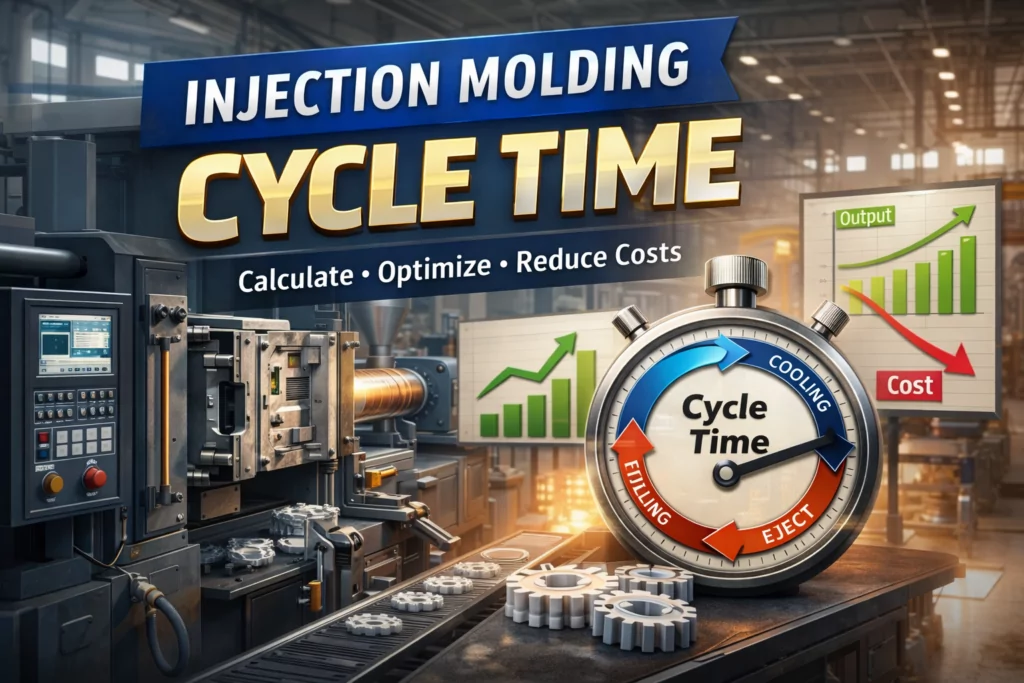
In modern manufacturing, efficiency is closely tied to how well production time is understood and controlled. This article is intended for engineers and production planners who need a practical understanding of how to use a cycle time calculator injection molding tool to improve output and cost accuracy. By mastering injection molding cycle time estimation, manufacturers can make better decisions during design, quotation, and production stages. Livepoint Tooling can facilitate this review by integrating mold design, cooling layout, and demolding performance with measurable production targets for each project.
Understanding the Role of Cycle Time Calculators
Injection molding cycle time refers to the total duration required to complete one full production cycle, including injection, packing, cooling, mold opening, ejection, and closing. Among these stages, cooling often accounts for the majority of the total time, making it the most critical factor in determining overall efficiency.
A cycle time calculator injection molding tool simplifies the estimation process by allowing engineers to input variables such as wall thickness, material type, and temperature conditions. Instead of relying on manual calculations, these tools provide instant estimates of injection molding cycle time, helping teams evaluate different design options before committing to tooling.
This approach is particularly useful during early project stages. During quotation and design optimization, a cycle time calculator injection molding tool enables quick comparisons between alternative designs. This helps identify opportunities to reduce cycle time without compromising product quality.
Practical Steps and Common Pitfalls
Using a cycle time calculator injection molding tool effectively requires accurate input data. Engineers should always use the maximum wall thickness rather than an average value, as cooling time increases significantly with thickness. Incorrect assumptions in this area can lead to underestimating injection molding cycle time.
Material selection is another key factor. Different plastics have varying thermal properties, which directly affect cooling behavior. Adjusting parameters such as melt temperature and mold temperature within the calculator ensures more reliable results.
It is also important to consider mold design. Cooling channel layout can significantly influence injection molding cycle time, sometimes more than the material itself. Ignoring this factor is a common mistake that can lead to inaccurate predictions.
Livepoint Tooling applies these principles by combining engineering expertise with advanced calculation tools. Their approach ensures that cycle time estimates are aligned with real production conditions, helping clients achieve more predictable outcomes.
Turning Data into Production Efficiency
Accurate cycle time estimation is essential for improving manufacturing performance. By using a cycle time calculator injection molding tool, engineers can better understand how design and process variables influence injection molding cycle time.
This insight allows manufacturers to optimize production parameters, reduce costs, and improve overall efficiency. For companies seeking to enhance competitiveness, integrating cycle time analysis into standard workflows is a practical step forward.
With structured methods and support from experienced partners such as Livepoint Tooling, businesses can transform cycle time from a constraint into a controllable advantage. In use a Cycle Time Calculator in Injection Molding, this added control helps manufacturers reduce avoidable revisions, improve supplier communication, and maintain steadier quality as the project moves from trial production to larger orders. Livepoint Tooling can support use a Cycle Time Calculator in Injection Molding by linking engineering decisions with practical mold-building and production-control experience. For use a Cycle Time Calculator in Injection Molding, the final manufacturing plan should connect design review, material selection, tooling execution, inspection standards, and production feedback in one coordinated workflow.